
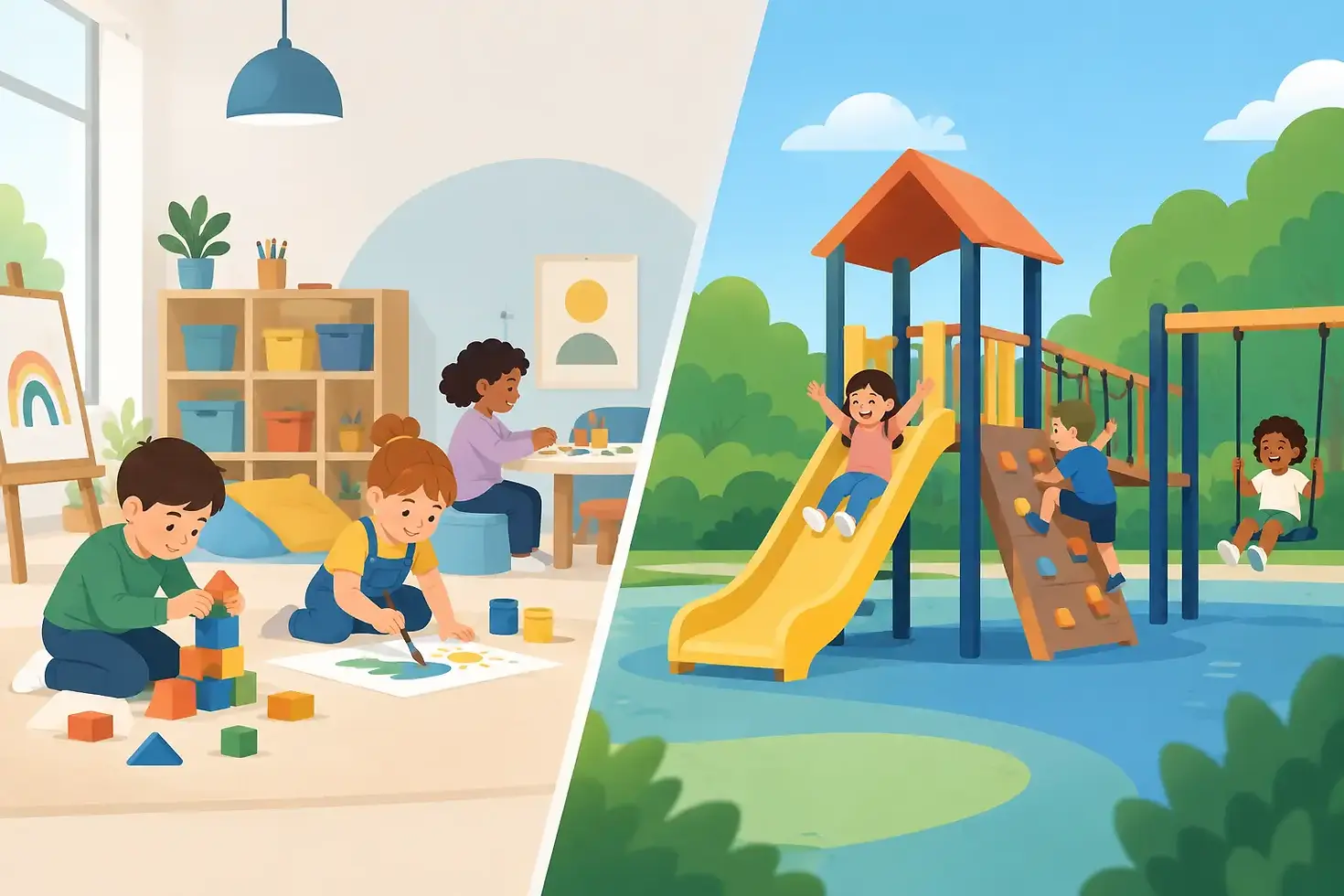
Play Studio Versus Playground for Young Kids

A child balancing on a mossy log, racing down a slide, or inventing a story in a tiny market is not simply passing time. They are testing ideas about their body, their world, and themselves. When parents consider play studio versus playground, the most useful question is rarely which one is better. It is which kind of play will meet their child where they are today.
Toronto families need both. A neighbourhood playground offers fresh air, spacious movement, and the lovely unpredictability of a shared public space. An intentional indoor play studio offers another kind of freedom: a weather-proof place where children can move, imagine, make, and linger in environments designed around childhood itself.
Play studio versus playground: the invitation to play
The difference begins with what each space quietly asks of a child. A playground often invites big physical action. Its structures are familiar: climb, swing, slide, spin, run. Children may arrive with an immediate plan, or create one as they spot friends across the park.
A play studio tends to offer a broader, more open-ended invitation. Rather than directing children toward one right way to use a structure, it may pair movement with loose parts, imaginative settings, art materials, sensory details, and spaces that can become anything a child needs them to be. A wooden arch might be a bridge, a hiding place, a mountain, or the beginning of a game no adult could have predicted.
What a playground does beautifully
Outdoor playgrounds give children room to stretch outward. The uneven ground, changing weather, sounds of birds and traffic, and chance encounters with other families create a rich sensory experience. For children who need to run hard, climb high, and feel the wind on their face, there is nothing quite like it.
They also invite healthy risk-taking. A child deciding whether they can reach the next rung or cross a tall climbing net is learning to read their own capabilities. Public playgrounds are especially wonderful when the day calls for open space, vigorous movement, and a dose of nature.
What a play studio does differently
A thoughtfully designed play studio can hold active movement and quieter forms of discovery in the same visit. A child may tumble, crawl, build, paint, care for a pretend animal, or settle into a small imaginative world. This range matters, particularly for toddlers and preschoolers whose needs can change several times in an hour.
The environment itself can be part of the learning. Natural materials, beautiful play sculptures, soft light, and carefully considered scale tell children that their ideas are worth taking seriously. At Liliput Playhouse, play is treated not as a distraction from meaningful learning, but as a meaningful artistic experience in its own right.
Development happens in both places
It can be tempting to sort play spaces into categories: playgrounds for gross motor skills, studios for imagination and creativity. Childhood is more beautifully tangled than that. A playground game can become an elaborate fantasy, while a play studio climbing structure can help a hesitant child build physical confidence one small attempt at a time.
Still, the emphasis may feel different. Outdoor play often supports whole-body coordination, stamina, spatial awareness, and resilience. Children learn to negotiate a busy climbing structure, wait for a swing, adapt to muddy shoes, or keep playing when the breeze turns cool.
In a play studio, children may have more opportunities to follow a self-directed story for longer. They can return to a building project, experiment with materials, or move between physical and imaginative play without needing to bring everything from home. This supports concentration, language, collaboration, and the deep satisfaction of making something personally meaningful.
There is an emotional dimension, too. Some children flourish in the bustle and scale of an outdoor playground. Others find it overwhelming, especially when equipment is crowded or play feels fast-paced. A welcoming indoor studio can offer smaller zones, gentler transitions, and caring adults nearby, helping children enter social play at their own pace.
Neither experience needs to be framed as more educational. Children do not benefit from a single ideal setting. They benefit from variety, repetition, challenge, rest, and adults who can notice what kind of play is calling to them.
How to choose for the day ahead
Your choice may come down to the weather, but it can also be guided by your child’s energy, age, and current interests. The right setting is the one that gives them room to be fully themselves, not the one that promises the most activities.
Choose a playground when movement is the main need
A playground may be the better fit when your child has been indoors all morning, needs a big physical reset, or is eager to meet friends outdoors. It is also ideal for children who enjoy unstructured social play and are comfortable navigating a louder, less predictable environment.
A visit can be delightfully simple. Bring water, dress for the conditions, and leave enough time for your child to repeat the same slide or climbing route again and again. Repetition is often where confidence grows.
Choose a play studio when the day needs more possibility
A play studio can be especially valuable on cold, rainy, or very hot Toronto days, when outdoor play is difficult but children still need to move. It also suits families looking for more than a quick energy burn: a place where imaginative play, art, sensory exploration, and physical discovery can unfold together.
For toddlers, an indoor environment designed for young children can make independent exploration feel more manageable. For siblings with different needs, a studio may offer more ways to participate side by side. One child can build a world while another climbs, then both can meet again in a shared story.
Consider your child’s social comfort
The busiest playground or the most beautiful studio will not feel magical if a child is already overstimulated. If your child has had a demanding week, look for a setting and time that allows them to ease in. A quieter morning studio visit may be more restorative than a crowded afternoon at the park.
On the other hand, a child who has been craving peers may come alive in a lively shared space. Watch for the signals they give you. Are they asking to run, make, pretend, observe, or stay close? Those small requests are useful guides.
The value of having both
The strongest childhood play rhythm is not an either-or choice. A week might include a muddy park visit, a walk to collect leaves, and an afternoon in an art-infused indoor play space. Each experience adds a different texture to a child’s inner life.
Outdoor playgrounds connect children to season, weather, neighbourhood, and the spontaneous life of their community. Play studios can create a distinct kind of refuge: an intentional place where childhood is not rushed, where materials are inviting, and where play can become a form of expression.
This is particularly meaningful for urban families. Not every home has a backyard, a craft room, or space to set up a sprawling pretend world and leave it there. Shared play spaces can offer what many families need most: enough room to move, enough beauty to inspire, and enough welcome to stay awhile.
Let the day set the pace
There will be afternoons when only the park will do, with its wild running, open sky, and imperfect joy. There will be other days when a child needs a warmer landing place, one where they can build a little world with their hands and inhabit it for a while. Both are gifts. Follow the play your child is reaching for, and let childhood remain wonderfully full of possibilities.


Comments